How to Tell If a Text Message Is a Scam (2026 Guide)
Your phone buzzes. It’s a text from your bank saying your account has been locked. Or maybe it’s a package delivery notice asking you to confirm your address. Or a government agency claiming you owe back taxes.
Should you click? Should you call back? Should you be worried?
In 2026, text message scams — also called smishing (SMS phishing) — are one of the fastest-growing forms of fraud in the United States. The FTC reported billions of dollars lost to text scams in recent years, and the numbers keep climbing. The good news: once you know what to look for, scam texts follow predictable patterns that are surprisingly easy to spot.
This guide walks you through the 10 most reliable warning signs of a scam text message, what scammers actually want, and what to do if you’ve already clicked.
What Is a Text Message Scam (Smishing)?
Smishing is a type of phishing attack delivered via SMS or messaging apps like iMessage, WhatsApp, or Telegram. Scammers send fraudulent text messages designed to trick you into:
- Clicking a malicious link that installs malware or steals your login credentials
- Calling a fake phone number where a scammer impersonates a real company
- Replying with personal information like your Social Security number, date of birth, or banking details
- Making an urgent payment via Zelle, Cash App, gift cards, or wire transfer
Smishing is exploding in 2026 because it works. People are more guarded with email phishing now, but many still trust a text message — especially when it appears to come from a trusted source.
10 Warning Signs a Text Message Is a Scam
1. It Creates a Sense of Urgent Panic
“Your account has been SUSPENDED.” “Final notice before legal action.” “Respond within 24 hours or lose your benefits.”
Urgency is the scammer’s most powerful tool. When you feel panicked, your critical thinking shuts down and you act impulsively — exactly what they want. Legitimate organizations like your bank, the IRS, or USPS will never demand immediate action via text message or threaten you with immediate consequences if you don’t respond right now.
What to do: Take a breath. Any real issue with a legitimate organization can wait 10 minutes while you verify through official channels.
2. The Sender Number Looks Odd
Real companies typically send texts from a registered short code (a 5 or 6-digit number like 73956) or a verified business number. Be suspicious of:
- Long, unusual strings of numbers
- International country codes (+1-900, +44, +52, etc.) when you weren’t expecting international contact
- A number that closely resembles a real company’s number but has one digit off
- Random 10-digit numbers that don’t match any known business
Scammers often spoof numbers to look legitimate, but many don’t bother — especially in bulk smishing campaigns.
3. It Contains a Suspicious or Shortened Link
This is one of the biggest red flags. If the text contains a link, look carefully at the URL before clicking anything. Common tricks include:
- Misspelled domains:
amaz0n.com,paypa1.com,netfl1x.com - Lookalike domains:
amazon-secure-account.cominstead ofamazon.com - URL shorteners:
bit.ly/xxxxxxxthat hide the real destination - Random character strings:
xhd92k.ccor.ru,.cn,.infodomains
Rule of thumb: If a link in a text doesn’t match the official website of the company it claims to be from, don’t click it. Go directly to the company’s website by typing the address yourself.
4. It Asks for Personal or Financial Information
No legitimate company will ask you to provide the following via text message:
- Social Security number
- Date of birth
- Bank account or routing numbers
- Credit or debit card numbers
- Passwords or PINs
- Medicare or insurance ID numbers
If a text is asking for any of this, it’s a scam. Full stop.
5. The Message Contains Spelling or Grammar Errors
While AI is making scam messages increasingly polished, many still contain telltale errors — awkward phrasing, inconsistent capitalization, strange punctuation, or language that simply doesn’t read naturally. Legitimate companies pay professionals to write their communications.
One typo doesn’t automatically mean scam, but combined with other warning signs, it’s a strong signal.
6. You Didn’t Expect the Text
Did you actually order a package? Do you actually have an account with that bank? Are you actually eligible for that government benefit?
Scammers send millions of texts using harvested phone number lists. They don’t know if you have a Bank of America account or not — they just blast the same message to everyone and wait for the people who happen to do. If you receive a text about an account, service, or situation that doesn’t apply to you, it’s almost certainly a scam.
7. It Offers Something Too Good to Be True
“You’ve been selected for a $1,000 Walmart gift card.” “Congratulations — you qualify for a $9,000 government stimulus.” “You’ve won a free iPhone 16.”
If you didn’t enter a contest, you didn’t win anything. These messages are designed to excite you just enough that you click before thinking. Once you do, you’re either being asked to “pay a small shipping fee” (they steal your card number) or redirected to a credential-harvesting site.
8. It Pretends to Be a Government Agency
The IRS, Social Security Administration, Medicare, and FEMA do not initiate contact via text message. If you receive a text claiming to be from any government agency — especially one threatening legal consequences or offering a payment — it is a scam.
The IRS specifically uses letters sent via U.S. Mail as its primary contact method. Any text claiming to be the IRS is fraudulent.
9. It Pressures You to Use a Specific Payment Method
Scammers love irreversible payment methods: gift cards, wire transfers, cryptocurrency, Zelle, Cash App, and Venmo. Why? Because once the money is sent, it’s nearly impossible to recover.
If any text message directs you to pay using these methods — especially with urgency attached — it is a scam. Legitimate businesses accept standard credit or debit card payments that come with fraud protections.
10. Your Gut Says Something Is Off
This one doesn’t get talked about enough. If you’re reading a text and something just feels wrong — pause. That instinct exists for a reason. Scammers are skilled at creating messages that are almost convincing. If you’re questioning whether a message is real, that question itself is your answer.
The Most Common Types of Scam Texts in 2026
Knowing the patterns helps you recognize them faster. Here are the most active smishing campaigns right now:
- Package delivery scams — Fake USPS, FedEx, or UPS texts claiming a package is held or needs a fee to be released
- Bank fraud alerts — Texts impersonating Chase, Bank of America, Wells Fargo, or credit unions claiming suspicious account activity
- Government impersonation — Fake IRS, SSA, Medicare, or FEMA texts
- Toll road scams — Texts claiming you owe unpaid E-ZPass or SunPass tolls (surging heavily in 2025–2026)
- Crypto investment scams — Texts from “friends” or strangers offering to teach you how to earn money with crypto
- Fake job offer texts — Especially work-from-home or Amazon delivery job offers
- Romance/relationship starts — “I think I texted the wrong number” openers that eventually lead to financial manipulation
- Tech support scams — Texts claiming your device is infected and directing you to call a number
What to Do If You Receive a Suspicious Text
Don’t click any links. Even if you’re 80% sure it’s a scam, don’t click.
Don’t reply. Replying confirms your number is active and invites more targeting.
Verify independently. If the text claims to be from your bank, call the number on the back of your card — not a number in the text. Log in to your account directly through your bank’s official app or website.
Report it. Forward suspicious texts to 7726 (SPAM) — it’s the industry standard shortcode for reporting smishing to your carrier. You can also report to the FTC at ReportFraud.ftc.gov.
Block the number. After reporting, block the sender to prevent further contact.
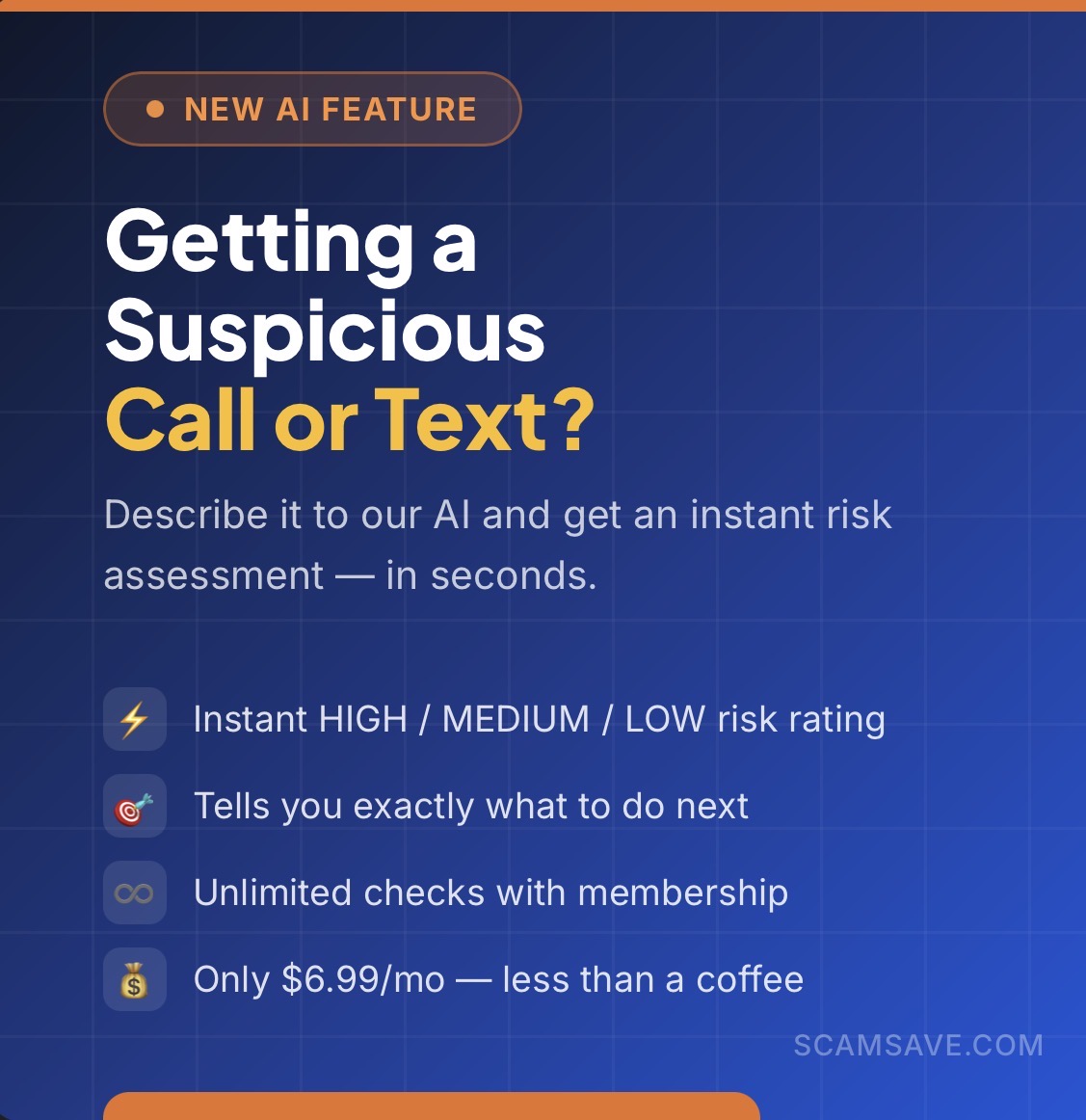
Still Not Sure? Use ScamSave’s AI Scam Triage Tool
Even with all these warning signs in mind, some scam texts are genuinely hard to judge. They look real. They use your name. They reference real companies you actually use.
That’s exactly why we built the ScamSave AI Scam Triage Tool.
Just paste the suspicious message — or describe what you received — and our AI instantly analyzes it against known scam patterns, current fraud databases, and real-world indicators. You’ll get a clear assessment of whether the message is likely a scam, what type of scam it resembles, and what your next step should be.
No technical knowledge required. No guesswork. Just answers.
👉 Try the ScamSave AI Scam Triage Tool — Free
Why ScamSave Members Stay One Step Ahead
The AI Triage Tool is just the beginning. ScamSave membership gives you ongoing protection through:
🔔 Real-Time Scam Alerts
Our scam news ticker pulls live data from the FTC, FBI IC3, and BBB Scam Tracker so you always know what’s circulating right now — not last month.
📋 The Top 100 Scams Database
A constantly updated reference library of the most active scams by category, so you can recognize threats before they reach you.
🛡️ Expert Guidance from a CISSP-Certified Professional
ScamSave is built and run by a Certified Information Systems Security Professional (CISSP) with decades of cybersecurity and fraud awareness experience. You’re not getting generic internet advice — you’re getting expert-level guidance written for everyday people.
📚 Member-Only Resources
Scam prevention guides, printable checklists, and educational content designed to protect you, your family, and your aging parents.
💬 Community + Support
Connect with others who’ve been targeted, share what you’ve seen, and get answers to your specific questions.
Scam losses in the U.S. now run into the tens of billions of dollars every year. Membership costs less than a single cup of coffee per month — and it could save you thousands.
👉 Become a ScamSave Member Today
Frequently Asked Questions
Can scammers fake a real phone number on a text?
Yes. This is called SMS spoofing, and it’s widely used. A text that appears to come from your bank’s real number can still be fraudulent. Always verify through official channels.
Is it dangerous to open a scam text if I don’t click anything?
Simply reading a text is generally safe. The risk comes from clicking links, calling numbers, or replying. That said, some MMS messages (picture/video texts) can carry malware — so if the preview looks suspicious, delete without opening.
What if I already clicked a link in a suspicious text?
Immediately close your browser. Do not enter any information on any page that opened. Change your passwords for any accounts that could be affected. Run a security scan on your device. Contact your bank if financial information may have been entered. Then report the scam to the FTC.
How do I report a text scam?
Forward the message to 7726 (SPAM). Report at ReportFraud.ftc.gov. If you lost money, also file a report with the FBI at IC3.gov.
Are scam texts getting worse?
Yes. AI is making scam texts more personalized, more believable, and harder to distinguish from real messages. Staying informed is your best defense — which is exactly what ScamSave is built for.
The Bottom Line
Scam texts follow patterns. Once you know the signs — urgency, suspicious links, unexpected messages, requests for personal info, too-good-to-be-true offers — you’ll catch most of them before they cause any harm.
But the scammers are getting smarter too. When you’re not sure, don’t guess alone.
ScamSave exists so you never have to face these threats without expert backup.
👉 Check a Suspicious Text with Our Free AI Triage Tool
👉 Join ScamSave and Stay Protected Year-Round
Written by a CISSP-Certified cybersecurity professional. ScamSave is dedicated to helping everyday people protect themselves from fraud, scams, and financial crime.